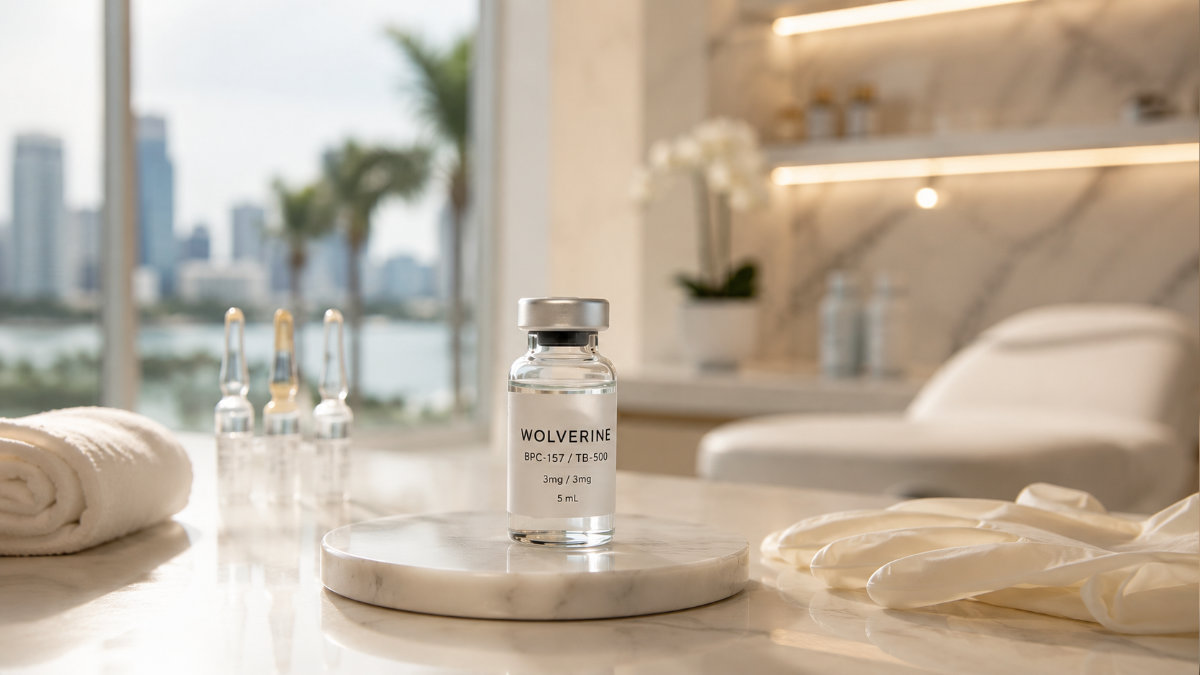
Some terms go viral before they become clear, and “Wolverine peptide” is one of them. It appears on social media, in longevity forums, and in conversations about recovery. But when a patient asks about it during a consultation, the real question is not whether it “works.” It is what substance the term actually refers to, what level of evidence supports it, and whether it makes sense within a serious longevity plan.
In aesthetics and wellness, attention-grabbing names often oversimplify. That can create unrealistic expectations or, worse, confusion about safety, indications, and product quality. That is why it is worth bringing clarity to the conversation before making any decisions.
Wolverine Peptide in Miami: Why It Draws So Much Attention
Interest in the Wolverine peptide comes from an appealing idea: supporting recovery and tissue-repair processes in a more targeted way than a conventional supplement. The term is commonly used to refer to peptides associated with regeneration, particularly the combination of BPC-157 and TB-500.
This is where the first important distinction appears. A peptide is a short chain of amino acids, or small building blocks the body uses as biological signals. But the fact that a substance is a peptide does not automatically make it appropriate for everyone or suitable for use without a prior evaluation. Peptides also differ in their evidence profiles, routes of administration, and clinical indications.
When someone searches for “Wolverine,” they are often looking for an implied promise of rapid recovery. From a clinical perspective, that promise should be translated into more useful questions: What are you trying to improve? Are we discussing performance, general well-being, recovery after exercise, support during a [longevity protocol](https://medilight.us/en/services/longevity-wellness-miami/), or a specific musculoskeletal concern? Without that precision, the name matters less than the context.
Which Substances Are Behind the Term “Wolverine Peptide”?
In practice, the name is most often associated with BPC-157 and TB-500. These compounds are widely discussed in biohacking and performance-medicine circles.
BPC-157 is often described as a peptide being studied for its potential role in repair processes. TB-500, meanwhile, is associated with mechanisms related to cell migration and tissue recovery. The interest is real, but that does not make either compound a universal recommendation.
What May Be Reasonable to Evaluate
Some patients seek a consultation after reading about peptides because they feel that recovery has slowed, experience persistent fatigue, train regularly, or want a more comprehensive wellness approach. In that setting, a peptide should not be evaluated as an isolated solution, but as one possible element within a broader strategy.
That means reviewing medical history, medications, actual goals, sleep quality, training habits, stress levels, body composition, and expectations. Sometimes the problem a person is trying to solve with a peptide has more to do with overtraining, a prolonged caloric deficit, inadequate recovery, or a poorly adjusted overall plan.
For that reason, at Medilight’s Longevity & Wellness Unit, peptide therapy is never approached as a stand-alone product or automatic answer. It is considered within personalized protocols and under clinical supervision, because the goal is not to follow a trend, but to determine whether that trend makes sense for a specific patient.
Risks of Seeking It Outside a Clinical Setting
With peptides, the greatest problem is not always the molecule itself, but the environment in which it is purchased and used. The online market is filled with products that may have inaccurate labeling, questionable purity, or insufficient traceability. Many recommendations also circulate without a medical history, interaction review, or follow-up plan.
The risk is not only that the product may “do nothing.” Inappropriate use, misaligned expectations, or delays in addressing an underlying problem can also occur. If someone has persistent pain, significant fatigue, or difficulty recovering, assuming that the answer is a peptide simply because it appeared on social media may cause an important evaluation to be missed.
In a serious clinical setting, the discussion should include contraindications, product quality, measurable goals, medical history, and an honest explanation of what is known, and what is still uncertain. That is the part that truly protects the patient.
When People Usually Ask About the Wolverine Peptide
Not every consultation begins from the same place. Some patients come from the fitness world and are looking for support with recovery after intense training. Others are less focused on performance and more interested in wellness, sustained energy, or support within a longevity program.
That difference matters because a 40-year-old professional woman with high stress, irregular sleep, and a sense of exhaustion is not evaluated in the same way as a 45-year-old man with a structured training routine and body-composition goals. The peptide name may be the same, but the clinical indication, if one exists, does not have to be.
Questions to Ask Before Considering It
Before deciding whether the Wolverine peptide is appropriate, it is worth pausing and asking something more useful than “Does it work?” The first question is what you are trying to improve. The second is what diagnosis or evaluation supports that decision. The third, very practically, is whether another option may be more appropriate for that goal.
It also matters who is supervising the protocol, how the quality of the compound is verified, and what follow-up plan is in place. If none of those answers are clear, it is probably not the right time to move forward.
Clinical Judgment Matters More Than the Trend
In longevity and wellness, sophistication is not about accumulating therapies. It is about selecting them carefully. A peptide may be part of a reasonable protocol in some cases, but that does not make it a universal tool or a shortcut. With the Wolverine peptide, the useful conversation does not begin with the promise of regeneration. It begins with the quality of the evaluation.
When a decision is made with clinical context, realistic expectations, and medical supervision, it becomes easier to distinguish between an option worth exploring and a trend that is better left alone. That is also the approach we use when evaluating therapies within Medilight’s Longevity & Wellness Unit: true personalization, medical judgment, and guidance throughout the process, not generic recommendations.
If you are researching these options and want to understand whether they make sense for you, the next step is not choosing a peptide by name. It is completing a personalized evaluation that brings clarity to your goals, medical history, and possible alternatives. At our Doral and Coral Gables locations, we can guide you with medical supervision, individualized protocols, and available financing options. Sometimes the best decision is not to do more, but to choose with greater precision.
Let’s design your longevity plan 📞 Call us: 786 413-0785Visit us:
📌7910 NW 25th St Suite 202, Doral, FL 33122
📌2710 Ponce de Leon, Coral Gables, FL 33134